Template: ElectraNet Generator Performance Standards (GPS) Assessment Guideline

Template version: v4
Country:

AU
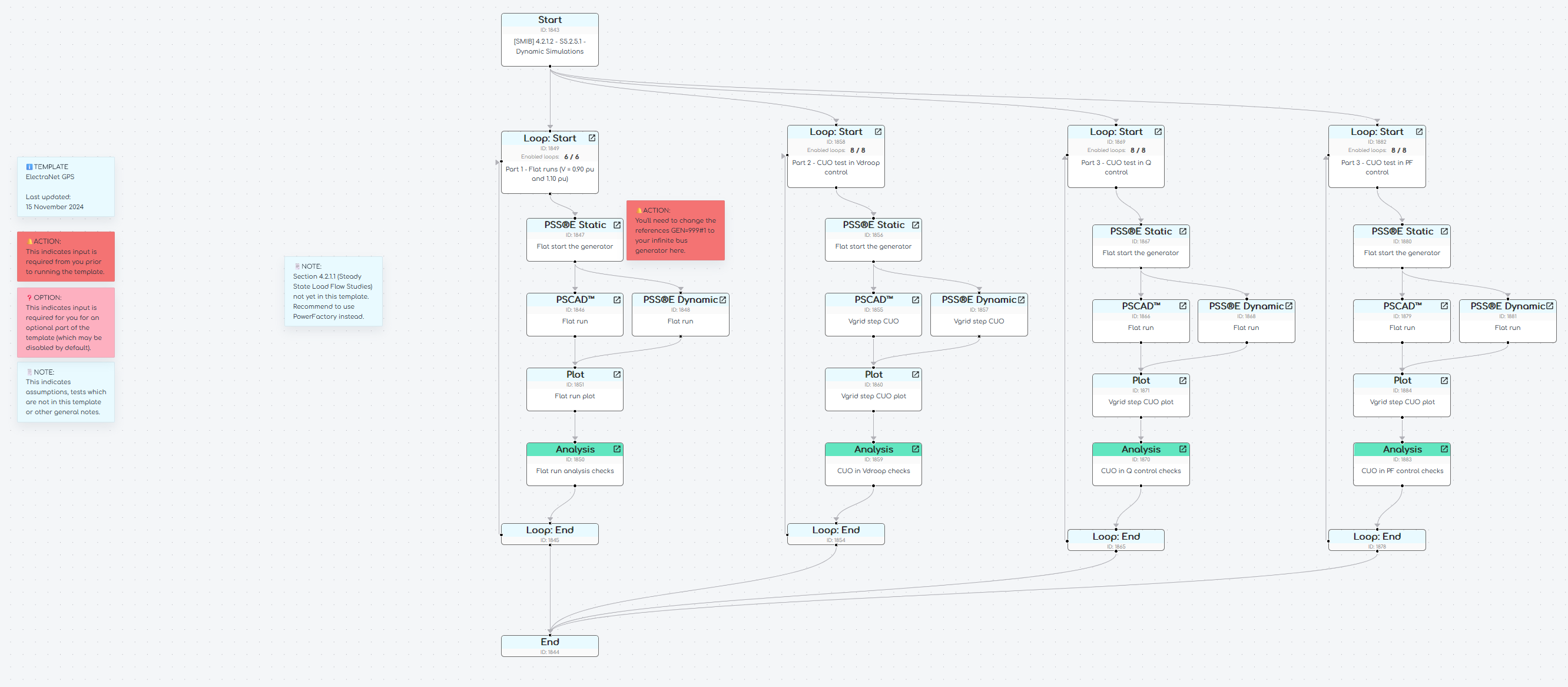
Software required:
Source: ElectraNet | Generator Performance Standard Assessment Guideline | Version 1.2 | 24 February 2025
How to add this template to your project
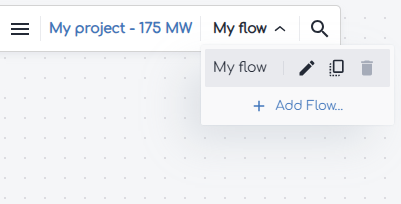
- From within your gridmo project, open the flow dropdown and select 'Add flow'.
- Select the template you want to use and click 'Add to project'.
Background
The following sections detail the assumptions and notes that have been made in the development of this template.
It is important to review the below assumptions and notes to ensure that the template is suitable for your project.
This template assumes National Electricity Rules (NER) Automatic Access Standard (AAS) compliance for all tests, unless otherwise specified.
The ElectraNet requirements document frequently specifies that tests are to be repeated at an initial active power setpoint of -1 p.u. This is only applicable for battery energy storage systems (BESS) or other generator types which act as loads (e.g. synchronous condensers).
If your project supports acting as a load, you will need to configure Scenario Variables to complete the entire template in this mode so you can undertake all of the tests that require active power of -1 per unit. This avoids lengthy template modifications to enable/disable loop variables with active power of -1 per unit.
ElectraNet often specifies the initial reactive power operating setpoint as 'Droop adjusted per VCS' and specifies the desired Vpoc voltage as 'VCS'. It is assumed when in voltage droop control, if the voltage at the point of connection is the same as the value specified in the VCS, then the initial reactive power operating point is 0 MVAr (i.e. Qpoc = 0).
This template uses the same rise time and commencement time calculation methodology as the ERC0393 GPS template. It also uses the same settling time methodology as the GPS template.
Where ElectraNet have specified the initial active power setpoint as P = 0 p.u., the template assumes the generator is initialised at Pmin (which is not necessarily P = 0 p.u.) This is because some projects may not be able to operate at 0 [MW] (e.g. a synchronous machine with a minimum active power operating point of 20%).
4.2.1 (S5.2.5.1) Reactive Power Capability
As per the requirements from ElectraNet, these S5.2.5.1 assessments should be repeated for two ambient temperature scenarios (e.g. 35°C and 50°C). This can be achieved using gridmo Scenario Variables.
4.2.1.1 Steady State Load Flow Studies
The purpose of this test is to establish the reactive power capability curves from the PSS®E SMIB model using static simulations.
- The main transformer tap position is unlocked.
- The test methodology involves trying to achieve Ppoc and Qpoc setpoints which are far beyond the rated capability of the plant (i.e. 1.5 [p.u.]) and then observing how far the plant reaches based on generating unit capability (e.g. Pmin, Pmax, Qmin and Qmax). This has two assumptions:
- Static controller commands of Pcmd of 1.5 [p.u] and Qcmd of 1.5 [p.u.] are sufficient to traverse the unconstrained capability of the generating system.
- The PSS®E generator model accurately models voltage dependent active and reactive power capability (i.e. Pmin, Pmax, Qmin and Qmax model voltage dependency correctly). Note that this is often a poor assumption for many PSS®E static models - even when using the GCAP functionality. Therefore, consider using a disaggregated model of the generating system in DIgSILENT PowerFactory (which is usually created for harmonic analysis) to complete these tests. This is because PowerFactory natively supports voltage-dependent reactive capability curves, unlike PSS®E, and has a built-in macro for generating a static PQ capability curve. Alternatively, consider running similar studies which utilise the PSS®E dynamic models since they will often more accurately represent the plant's voltage dependent active and reactive power capability.
4.2.1.2 Dynamic Simulations
The purpose of this test is to understand the reactive power capability performance of the generating system in different control modes using the PSS®E and PSCAD SMIB models under dynamic conditions.
- Assumed that the flat runs don't need to be repeated in Q control and PF control.
- It has also been assumed that an assessment of Qmax at 1.1 pu voltage, and Qmin at 0.9 pu voltage is not required. This is unclear in Table 2.
- The instruction to “increase the connection point voltage incrementally by 2% every 10 seconds” has been interpreted as a 2% step relative to nominal voltage, not the current voltage level. This same basis has been used for the reactive power and power factor steps.
4.2.2 (S5.2.5.3) Generating Unit Response to Frequency Disturbances
- Table 3 - Rows 1, 2 and 8: For the frequency trip assessments, there is no step back to 50 Hz.
- Table 3 - Rows 3-7: The 'Test duration' column e.g. 65 s is assumed to be the duration of the frequency disturbance. Given the study name is in the form of '47 Hz at ±4Hz/s' both the frequency step to 47 Hz and step back to 50 Hz have been modelled.
- Table 3 - Rows 1, 2 and 8: The durations used for the frequency disturbance trip tests have been assumed and should be adjusted to validate the protection settings in the model.
- Table 3 - Rows 1 and 2: This template assumes your generating system will trip for frequencies 46.9 Hz and lower, hence the 45 Hz at 3 Hz/sec ROCOF test and 46.9 Hz at 4 Hz/sec ROCOF tests have been combined into a single Loop Start Node (as they are both under-frequency trip tests)
4.2.3 (S5.2.5.4) Generating System Response to Voltage Disturbances
The 'UV profile tests' and 'OV profile tests' in Table 4: Dynamic studies to assess S5.2.5.4 of the ElectraNet requirements reference a final voltage of 0.90 p.u. for the over-voltage ride-through profile and 1.10 p.u. for the under-voltage ride-through profile. This differs from the normal S5.2.5.4 automatic access profile. In compliance with the requirements, this template has a voltage profile which:
- (Under-voltage) Steps immediately from
0.80p.u. to1.10p.u. and - (Over-voltage) Steps immediately from
1.15p.u. to0.90p.u.
The durations used for the voltage disturbance trip tests have been assumed and should be adjusted to validate the protection settings in the model.
The 'Individual voltage step tests' section of Table 4: Dynamic studies to assess S5.2.5.4 of the ElectraNet requirements is unclear on how long the 0.90 p.u. and 1.10 p.u. voltage disturbances should be applied for; it instead refers to the duration 'As per AAS'. The Automatic Access Standard (AAS) for S5.2.5.4(a)(6) of the NER specifies that a generator must remain connected indefinitely for a voltage disturbance in this range.
This template assumes 1200 seconds is sufficiently long to demonstrate ride-through capability for a voltage disturbance in this range.
The playback signal data presented by ElectraNet in Table 5 applies the disturbance at t = 1 second.
In the gridmo template, the disturbance is applied at t = 5 seconds to allow time for model initialisation.
ElectraNet specifies that the S5.2.5.4 assessments should be completed in Voltage droop control mode. Where it is not specified, the template assumes voltage droop control mode is used.
4.2.4 (S5.2.5.5) Responses to Disturbances following Contingency Events
4.2.4.1 [Network] Single Fault Disturbance
Section 4.2.4.1 of the ElectraNet requirements specifies several NEM/OPDMS PSS®E snapshot models to use for this test. Inputs you require from AEMO/ElectraNet to complete this section are as follows. These inputs are not provided in this template.
- Tuned raw/seq/dyr PSS®E NEM snapshot files of the scenarios specified in the ElectraNet requirements (or as otherwise agreed with AEMO/ElectraNet).
- A list of faults to apply in the PSS®E NEM snapshot files, including clearance times and auto-reclose settings.
- Information on nearby generators, including their Voltage Control Strategies (VCS).
Our template is pre-configured for two distinct PSS®E NEM snapshot files. If you are using additional, copy everything between Loop Start Node 1983 and Loop End Node 1987 and update as required.
4.2.4.2 [SMIB] Multiple Fault Ride-Through (MFRT)
The ElectraNet requirements specify that a fault sequence 'aligned with AAS' is to be used. This template is configured to use sequences P6 and P7 using the MULTIFAULT command, which meet the automatic access standard (AAS) criteria of S5.2.5.5(d) of the NER.
Table 8: Dynamic studies to assess MFRT for S5.2.5.5:
- Assumed to be balanced fault sequences as the tests specifies both PSS®E and PSCAD™ results are required.
- This table specifies a fault duration of 'Primary protection clearance times and circuit breaker failure'. This is unclear, we've instead used an unbalanced fault sequence compliant with S5.2.5.5(d) of the NER. Balanced fault sequences are not applied as the test is specified as PSCAD™ only.
- This table specifies
Vpocto be as perVCS(voltage control strategy) - the initial conditions required are unclear, we've assumed the test should be completed with:- The generator in its default voltage/reactive power control mode (as per its VCS)
- The point of connection voltage to the default (as per the global variable
default_poc_voltage) - Repeated at Qmin, Q0 and Qmax
4.2.4.3 [SMIB] Reactive Current Injection, Rise Time and Settling Times
This template combines the 'Capacitive current tests: Balanced faults' and 'Inductive current tests' into a single Loop Start Node so a combined balanced iq scatter plot can be created.
Note ElectraNet has specified that this test must be completed at all permutations of Pmax/Pmin and Qmax/Qmin, with the exception of Pmin and Qmin.
Table 9: Dynamic studies to assess reactive current injection for S5.2.5.5 specifies that capacitive current tests (LVRT) are to be completed using a fault, but inductive current tests (HVRT) are to be completed using a playback generator.
We've instead implemented HVRT tests via a capacitor switch-in, as applying a playback generator for large voltage deviations can lead to strange inverter performance, as there isn't actually a disturbance present to sink fault current.
Table 9: Dynamic studies to assess reactive current injection for S5.2.5.5 specifies that settling time, active power recovery time, reactive current rise and settling times must be provided at multiple points throughout the generating system. Our template assumes only point of connection values are necessary; this also minimises the size of summary tables generated by Table Nodes in this template.
Table 9: Dynamic studies to assess reactive current injection for S5.2.5.5 specifies the initial voltage is specified as 'Initialised voltage between 1pu to the expected voltage level based on historical data' - this is unclear, we've assumed the test should be completed with:
- The generator in its default voltage/reactive power control mode (as per its VCS)
- The point of connection voltage to the default (as per the global variable
default_poc_voltage)
Table 9: Capacitive current tests: Unbalanced faults specifies POC voltage dips from 0.95 pu to 0.0 pu in 0.05 pu increment. This is possible for 2PHG and PHG faults, however this is not achievable for PHPH (2P) faults. Even with a zero impedance PHPH fault, the residual voltage at the POC for the faulted phases is about 0.5 pu.
4.2.6 (S5.2.5.7) Partial Load Rejection
Section 4.2.6 of the ElectraNet requirements specifies several NEM/OPDMS PSS®E snapshot models to use for this test. These inputs are likely the same as used for section 4.2.4.1.
Our template is pre-configured for two distinct PSS®E NEM snapshot files. If you are using additional, copy everything between Loop Start Node 2050 and Loop End Node 2054 and update as per below.
With this information, complete the following:
- Loop Start Nodes
2050(NEM PSS®E snapshot 1) and2061(NEM PSS®E snapshot 2):- Set all the loop variables in this Node (excluding
l_pcmdandl_qcmd) based on a load reduction event you are simulating (for example, a trip of a large smelter load in Victoria, or the loss of an interstate interconnector e.g. Heywood-SESS or PEC)
- Set all the loop variables in this Node (excluding
- PSS®E Static Nodes
2051&2059(NEM PSS®E snapshot 1) and2062&2067(NEM PSS®E snapshot 2):- Set the
Network modelandNetwork model: Bus numberfields to allow gridmo to auto-merge your SMIB model into the specified NEM snapshot file. - Add
CONTROLcommands to put your generating system into its default voltage control mode in a PSS®E Static Node (e.g. using aCONTROL, GEN=, Q=VDROOP...command). - Add
CONTROLcommands into this Node to set the initial conditions of nearby generation based on their respective VCS.
- Set the
- PSS®E Dynamic Nodes
2052&2060(NEM PSS®E snapshot 1) and2063&2068(NEM PSS®E snapshot 2):- Set the
Network dynamics model datato a folder containing all.dyrfiles for your NEM PSS®E snapshot. - Set the
Network dynamics user modelsto a folder containing all.dllfiles for your NEM PSS®E snapshot, including thedsusr.dlllibrary.
- Set the
The SMIB over-frequency ride-through test specified in Table 10: Dynamic studies to assess S5.2.5.7 implies, but doesn't specify, that the frequency should ramp down to nominal during the test (by the inclusion of the requirement that 'the generating system maintains CUO following the disturbance').
Our template is configured to ramp the frequency back down to nominal after 10 seconds.
4.2.7 (S5.2.5.8) Protection from Power System Disturbances
The tests 'Frequency disturbances to just outside of the protection settings' in Table 11: Dynamic studies to assess S5.2.5.8 are a functional duplicate of the tests in section 4.2.2 of the same document (S5.2.5.3) - specifically Loop Start Node 1887 and 1920.
The tests 'Voltage disturbances to just outside of the protection settings' in Table 11: Dynamic studies to assess S5.2.5.8 are a functional duplicate of the tests in section 4.2.3 of the same document (S5.2.5.4) - specifically Loop Start Node 2567.
We've assumed that these tests do not need to be duplicated.
4.2.8 (S5.2.5.11) Frequency Control
All specified frequency changes are completed at a maximum ramp rate of 4 Hz/sec, with a minimum resolution of 250 mHz for the P(f) scatter plot.
In Table 12, ElectraNet specifies that the initial active power for the UF frequency changes is P = 1 pu. This template instead assumes an initial active power of Pmin because if the generator is initialised at Pmax (P = 1 pu), there will be no active power response to frequency changes.
4.2.9 (S5.2.5.12) Impact on Network Capability
The following tests from Table 13: Steady state and dynamic studies to assess S5.2.5.12 are not included in this template:
- 'Contingency studies - steady state and dynamic'
- 'Inter network damping study' The tests specified in these sections are very similar to that of section 4.2.4.1 (S5.2.5.5) and section 4.2.6 (S5.2.5.7) and likely could be completed using the same PSS®E Nodes, possibly with additional NEM/OPDMS snapshots and additional disturbance scenarios.
The 'intra-plant damping study' section of Table 13: Steady state and dynamic studies to assess S5.2.5.12 is included - however is specified to only be completed in PSS®E.
Typically, small signal damping studies are completed in PSCAD™ - hence we have included an optional PSCAD™ Node for this test.
4.2.10 (S5.2.5.13) Voltage and Reactive Power Control
SMIB step and limiter tests
As per ElectraNet requirements, the tests below apply for all three typical voltage control modes (Vdroop, Q control and PF control). If your generating system does not support one or more of these control modes, you will need to disable several Loop Start Nodes in this template.
The tests 'Reactive power set point reference steps' in Table 14: Dynamic studies to assess S5.2.5.13 have quite large reactive power step tests (up to +/- Qmax in a single step) and a requirement to output the rise and settling time for each step.
Our template is configured to output these values - however, we note that S5.2.5.13(c1)(3) of the NER implies that 50% PFref or Qref step is the largest step which needs to meet the rise and settling time requirements as per the NER.
The initial reactive power conditions for set point reference tests in Table 14: Dynamic studies to assess S5.2.5.13 (voltage, reactive power and power factor) are unclear. We've assumed that all tests should be repeated at Qmax, Q=0 and Qmin - to show reactive power injection does not exceed the specified capability.
This does mean that the expected performance for some of these tests is a flat run. For example, if your generating system initialised at Qmax, the generator should not inject more than Qmax, even if the Vref/Qref/PFref input steps to a value which implies a reactive power injection greater than Qmax.
The above does not apply to the limiter tests.
The power factor reference values in Start Nodes l_step1_pf_equiv_to_25percent_q and l_step2_pf_equiv_to_50percent_q are pre-calculated based on a project maximum reactive power capability of 0.395 per unit (active power base), as specified in S5.2.5.1 of the NER. If your project has a different P-Q capability, you will need to adjust these values.
ElectraNet specifies in Figure 7 that the power factor setpoints for capacitive capability tests are run for 350 seconds and step down to a power factor of 0.32. When the generating system is operating at Pmax, it hits the reactive power limiter after four power factor steps (reaching a 0.92 power factor at 40 seconds). For these cases, we assume a test duration of 50 seconds is sufficient. However, when the tests are run at Pmin, they are set to run for the full 350-second duration as each power factor step represents a much smaller change in reactive power at this active power level.
Network step and disturbance tests
This section repeats the above reference tests using several NEM/OPDMS PSS®E snapshot models. These inputs are likely the same as used for section 4.2.4.1.
Note there are several nodes to configure for this section due to the duplication required for each reactive power control mode and specified NEM/OPDMS PSS®E network case.
Reference control steps
- PSS®E Static Nodes
2272,2298,2317(NEM PSS®E snapshot 1) and2282,2305,2324(NEM PSS®E snapshot 2):- Set the
Network modelandNetwork model: Bus numberfields to allow gridmo to auto-merge your SMIB model into the specified NEM snapshot file. - Add
CONTROLcommands to put your generating system into its default voltage control mode in a PSS®E Static Node (e.g. using aCONTROL, GEN=, Q=VDROOP...command). - Add
CONTROLcommands into this Node to set the initial conditions of nearby generation based on their respective VCS.
- Set the
- PSS®E Dynamic Nodes
2273,2299,2318(NEM PSS®E snapshot 1) and2283,2306,2325(NEM PSS®E snapshot 2):- Set the
Network dynamics model datato a folder containing all.dyrfiles for your NEM PSS®E snapshot. - Set the
Network dynamics user modelsto a folder containing all.dllfiles for your NEM PSS®E snapshot, including thedsusr.dlllibrary.
- Set the
Network voltage disturbance tests
- Loop Start Nodes
2201,2228,2252(NEM PSS®E snapshot 1) and2212,2237,2259(NEM PSS®E snapshot 2):- Modify the
Q=argument of eachADDcommand in thel_eventloop variable in order to induce an over-voltage/under-voltage event at the point of connection. As this is a network model (with potentially variable system strength depending on the base case and in service generation) you will need to test a series of events to identify what size of capacitor/reactor to use to induce the required voltage disturbance. Also update thel_event_descriptionloop variable to describe the event on the output plots.
- Modify the
- PSS®E Static Nodes
2202,2210,2229,2235,2253,2257(NEM PSS®E snapshot 1) and2213,2218,2238,2243,2260,2264(NEM PSS®E snapshot 2):- Set the
Network modelandNetwork model: Bus numberfields to allow gridmo to auto-merge your SMIB model into the specified NEM snapshot file. - Add
CONTROLcommands to put your generating system into its default voltage control mode in a PSS®E Static Node (e.g. using aCONTROL, GEN=, Q=VDROOP...command). - Add
CONTROLcommands into this Node to set the initial conditions of nearby generation based on their respective VCS.
- Set the
- PSS®E Dynamic Nodes
2203,2211,2230,2236,2254,2258(NEM PSS®E snapshot 1) and2214,2219,2239,2244,2261,2265(NEM PSS®E snapshot 2):- Set the
Network dynamics model datato a folder containing all.dyrfiles for your NEM PSS®E snapshot. - Set the
Network dynamics user modelsto a folder containing all.dllfiles for your NEM PSS®E snapshot, including thedsusr.dlllibrary.
- Set the
4.2.11 (S5.2.5.14) Active Power Control
The 'Active power reference steps' specified in Table 15: Dynamic studies to assess S5.2.5.14 are configured assuming that there is not an active power rate limiter in your generating system, as the tests are only to demonstrate capability to regulate to the specified setpoint.
If an active power ramp rate limiter is included in your generating system, you will need to increase the simulation time in all Nodes in this section to at least 305 seconds to demonstrate ramping over 5 minutes (including initialisation time). Note that these PSCAD™ simulations may take several hours to complete.
The Pmin limiter tests specified in Table 15: Dynamic studies to assess S5.2.5.14 of the ElectraNet requirements may inadvertently indicate that there is not a minimum active power limiter for BESS projects, as a -0.10 p.u. relative step from Pmin will instruct a BESS to start charging. If your generating system is a BESS, disable any rows in the Loop Start Node 2356 which have l_pcmd equal to 0.1 (there are 4 rows with this value).
The 'Limit tests: Pmin - 10%, Pmax + 10%' specified in Table 15: Dynamic studies to assess S5.2.5.14 may not clearly illustrate that a limiter has activated, as the generator is being initialised at maximum power and then instructed to step into the limiter it is already at.
We've assumed that, similar to section 4.2.9 (S5.2.5.13), the tests should instead be at P=0.90 p.u. with a relative step of 0.20 p.u. and P=0.10 p.u. with a relative step of -0.20 p.u. to demonstrate the limiter activating.
4.2.12 (S5.2.5.15) Short Circuit Ratio
The tests in this section are a subset of the tests required as per the AEMO System Strength Impact Assessment Guidelines (SSIAG) template. However, for completeness, the tests are repeated here with the requirements as per the ElectraNet document.
The 'Grid voltage impulse with site-specific X/R range' test as part of Table 16: Dynamic studies to assess S5.2.5.15 does not specify the actual impulse to apply.
We've assumed the impulse is the same as tests 2 and 3 of Table 3 of Appendix B of the AEMO SSIAG (a -0.05 p.u. impulse and -0.1 p.u. impulse, both applied for 40 ms).
The fault duration is not specified; a 430 ms duration has been assumed in alignment with the AEMO SSIAG.
4.2.13 (S5.2.5.16) Voltage Phase Angle Shift
The duration of the voltage phase angle change is not specified; 10 seconds duration for each step has been assumed.
Sources
- ElectraNet | Generator Performance Standard Assessment Guideline | Version 1.2 | 24 February 2025 (not publicly available)
Revision history
Version 4 | 7 May 2026
New- General: Alignment with new ElectraNet requirements (v1.2).
- Section 4.2.1.1 (S5.2.5.1): Steady state load flow reactive power capability studies added
- Section 4.2.13 (S5.2.5.16): New clause
- Section 4.2.1.2 (S5.2.5.1): Dynamic simulations modified to match the new ElectraNet requirements (v1.2).
- Section 4.2.2 (S5.2.5.3): Assessment methodology modified to match the new ElectraNet requirements (v1.2).
- Section 4.2.3 (S5.2.5.4): Assessment methodology modified to match the new ElectraNet requirements (v1.2).
- Section 4.2.4.2 (S5.2.5.5): MFRT loop node, added
l_vpocloop to represent V_Qmax, V_Q0, V_Qmin. - Section 4.2.4.3 (S5.2.5.5): Increased the number of loops to align with new ElectraNet requirements (v1.2).
- General: Many minor improvements such as adding units to Table columns, naming consistency, etc.
- Section 4.2.9 (S5.2.5.12): Methodology updated to have voltage magnitude step applied by playback rather than as fault. Corresponding Analysis Node also updated.
- Units added to Table columns where missing.
Version 3 | 16 April 2025
Fixed- Fixed incorrect Internode Variable name in Table Nodes
2235,2236,2237,2238,2239,2240,2241,2242,2243,2244,2245,2246for Ppoc - settling time. - Fixed incorrect Internode Variable name in Plot Node
2292for frequency at POC. - Fixed incorrect Internode Variable name in Plot Nodes
2164and2178for Qpoc - final value. - Added applied test displays for 4.2.3 (S5.2.5.4) Generating System Response to Voltage Disturbances.
- Fixed incorrect reference to Delta Vpoc in Plot Node
2039. Added newADVOUTPUTcommand positive sequence Vpoc in Plot Node2033, updated linked Table Node2029to use this new Internode Variable and updated Plot Node2039(FRT injection curve scatter plot) to use positive sequence voltage.
Version 2 (v1.4.19) | 27 November 2024
- Removed extra blank subplot (was present in only some Plot Nodes).
- Fixed template mapping issue which caused LVRT and HVRT signals to not appear on the specified sub-plots.
Version 1 (v1.4.18) | 25 November 2024
- First template release