Template: NESO Grid Code - Grid Forming Requirements (ECP.A.3.9)

Template version: v1
Country:

UK
Software required:
Source: NESO | The Complete Grid Code | Issue 6 – Revision 36 | 12 December 2025
How to add this template to your project
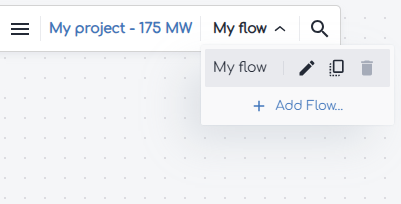
- From within your gridmo project, open the flow dropdown and select 'Add flow'.
- Select the template you want to use and click 'Add to project'.
Background
NESO's Grid Code specifies compliance requirements for grid forming technologies in the Grid Code's European Compliance Processes (ECP) section, with ECP.A.3.9 including the technical details of the simulation studies to be conducted. Appendix C of NESO's Grid Forming Guidance Note provides additional details of these simulation studies for the following sections of ECP.A.3.9:
- ECP.A.3.9.4 - ROCOF response
- ECP.A.3.9.4 - Phase jump response
- ECP.A.3.9.4 - Fault ride through and Fast Fault Current Injection (FFCI)
- ECP.A.3.9.5 - ROCOF and phase jump response
- ECP.A.3.9.6 - Active damping power
This template includes tests for the above based on the simulation requirements specified in NESO's Grid Forming Guidance Note.
Reference
Common assumptions
- It is assumed that all tests in this template are only required for PSCAD™, based on feedback from industry partners.
- This template does not include Analysis Nodes by default, as the specific assessment criteria for each test is not specified in the Grid Code or NESO's Grid Forming Guidance Note.
- For all tests, it is assumed that enabling/disabling 'voltage control mode' is referring to the voltage control functionality typically provided by an inverter based technology's power plant controller. Hence to 'disable' voltage control mode, the WECC solar model is put into reactive power control mode in this template using the Global Variable
pscad_disable_voltage_control. - For all tests, the voltage at which the tests should be performed has not been specified in the test requirements. The Global Variable
neso_gfm_vpoccan be configured to specify the voltage for all tests. - For all tests, the SCR and X/R ratio at which the tests should be performed has not been specified in the test requirements. The Global Variables
neso_gfm_scrandneso_gfm_xrcan be used to configure the SCR and X/R ratio for all tests (e.g. system normal or minimum SCR).
ECP.A.3.9.4 - ROCOF response
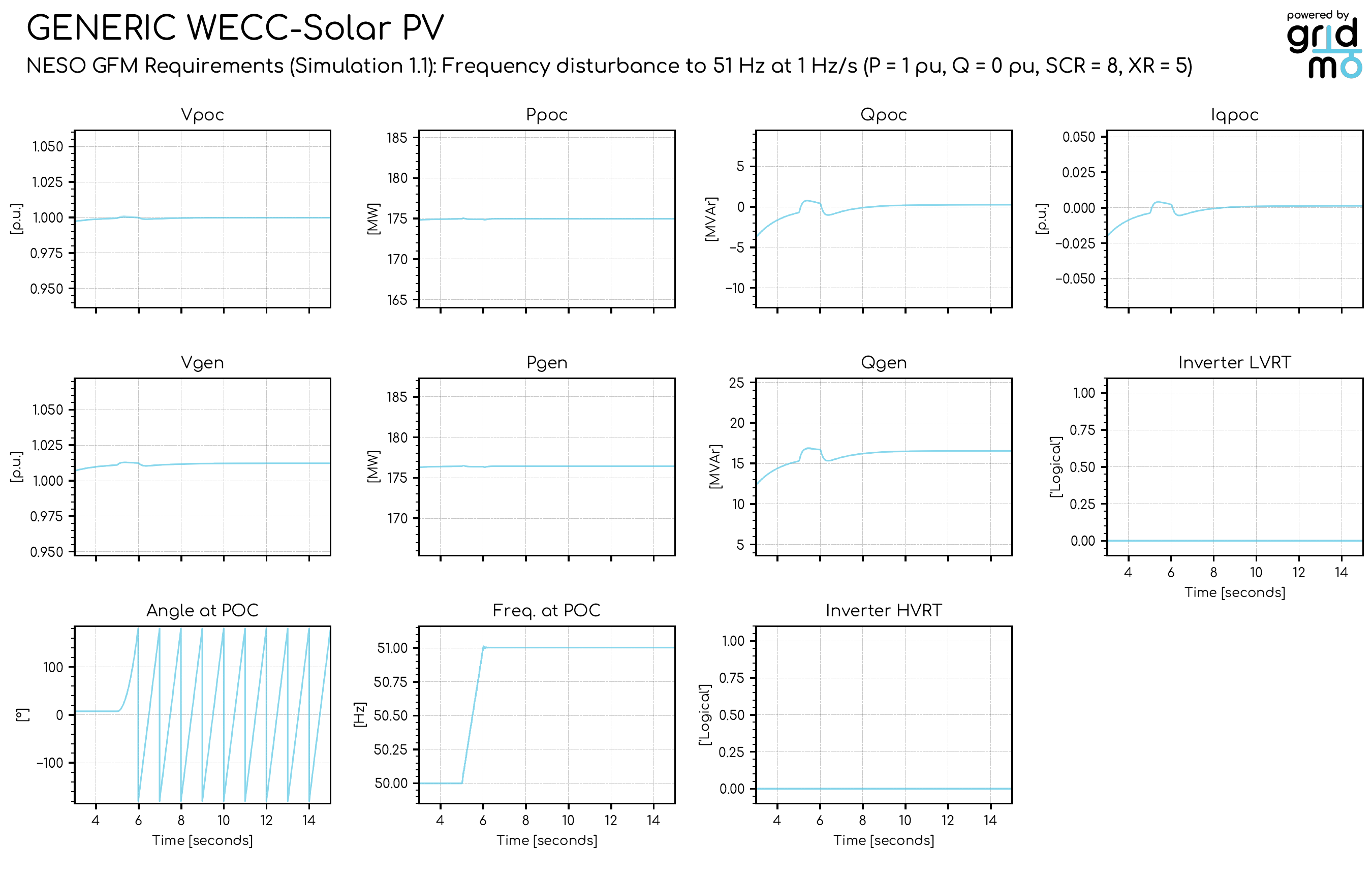
The purpose of these tests (Simulation 1.1-3.2) is to demonstrate the grid forming plant's ability to provide Active ROCOF Response Power across a range of frequencies.
- Simulation 1.1 - Simulation 2.4: The initial reactive power output is not specified for these tests. We have assumed initial Qpoc = 0 MVAr, similar to Simulation 3.1 and 3.2.
- For Simulation 3.1 and 3.2, it is not clear if the source energy (or available power) needs to be adjusted along with the initial active power. Hence, this has not been done by default in this template.
ECP.A.3.9.4 - Phase jump response
The purpose of these tests (Simulation 4.1-5.4) is to demonstrate the grid forming plant's ability to provide Active Phase Jump Power.
ECP.A.3.9.4 - Fault ride through and FFCI
The purpose of these tests (Simulation 6.1-6.2) is to demonstrate the grid forming plant's ability to supply fault ride through capability and fast fault current injection (FFCI).
- We have interpreted a "solid three phase short circuit fault" to mean a fault impedance of 0 [Ω] (i.e. bolted fault).
ECP.A.3.9.5 - ROCOF and phase jump response
The purpose of this test (Simulation 7) is to demonstrate the grid forming plant's ability to provide Active ROCOF Response Power and Active Phase Jump Power under extreme conditions.
- We have interpreted a "solid three phase short circuit fault" to mean a fault impedance of 0 [Ω] (i.e. bolted fault).
ECP.A.3.9.6 - Active damping power
The purpose of these tests (Simulation 8.1-8.3) is to demonstrate the grid forming plant's ability to provide Active Damping Power. These tests are not yet included in this template.
Sources
- NESO | Grid Code | Issue 6 – Revision 36 | 12 December 2025
- NESO | Grid Forming Guidance Note | Issue 3 | 16 September 2025
Revision history
Version 1 | 30 January 2026
- First release.