Template: Transgrid SVWSS requirements for GFM BESS

Template version: v1
Country:

AU
Software required:
Source: Transgrid | Transgrid's technical performance and power system modelling requirements for stable voltage waveform support services from grid-forming BESS | 17 June 2024
How to add this template to your project
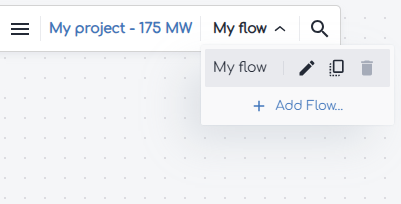
- From within your gridmo project, open the flow dropdown and select 'Add flow'.
- Select the template you want to use and click 'Add to project'.
Background
System strength is the ability of a power system to maintain and control a stable voltage waveform. Over the coming decades, the retirement of coal generators and the growth of inverter-based resources will require new methods for maintaining system strength in the power system. To address this, Transgrid applied a Regulatory Investment Test for Transmission (RIT-T) to evaluate a number of solutions for providing system strength to the NSW power system. Grid-forming inverter-based battery storage systems (GFM BESS) were one of the solutions explored during this process.
As part of this process, Transgrid has developed the Technical performance and power system modelling requirements for grid-forming BESS document, which provides the minimum tests required to be performed by a GFM BESS proponent before they can provide stable voltage waveform support services (SVWSS) in NSW.
Transgrid have outlined four criteria for a stable voltage waveform:
- Voltage magnitude
- Changes in voltage phase angle
- Voltage waveform distortion
- Voltage oscillations
GFM BESS are expected to assist with criteria 1, 2 and 4 above. To demonstrate this assistance, Transgrid have specified the "minimum tests required to be performed by a GFM BESS proponent" in Table 3. These required tests have been grouped in our template as follows:
- Test 1-3: Voltage drop through a remote fault
- Test 4-6: Grid voltage oscillation
- Test 7-9: Frequency event at different ROCOFs (via playback)
- Test 10-12: Local faults at controlled bus
- Test 13: Multiple faults concurrent with a frequency event
- Test 14: Trip of a local synchronous machine
- Test 15: Load rejection and extreme overvoltage disturbance
- Test 16: Energising RL loads in island mode (Black Start Service only)
- Test 17: Unbalanced voltage disturbance
This template does not currently contain tests for Test 14 and Test 16.
Reference
Common assumptions
- All tests are configured for Ppoc=0 and Ppoc=Pmax initial conditions. To meet the requirements, you must use Scenario Variables to conduct tests at Ppoc=0 and Ppoc=Pmin in accordance with the requirements.
- All tests are performed at Qpoc=0 initial conditions.
- All tests are performed at SCR=1.2 and SCR=20 as specified in the requirements, except for tests where a different SCR is specified in Table 3 of the requirements. However, X/R ratio has not been specified. We have assumed that $max_xr is used with SCR=20 and $min_xr is used with SCR=1.2.
- As initial Vpoc has not been specified in the test descriptions, we have assumed "default connection point voltage [p.u.]" (i.e. $default_poc_voltage). This can be set as 1.0 [p.u.] if desired.
- All the tests in this template are designed for SMIB models. This template does not contain the optional Multi Machine Infinite Bus (MMIB) model tests.
- All unbalanced fault tests have been conducted in PSCAD™ only.
- By default, each Plot Node has x-axis: Min [seconds] set as 3 seconds to exclude the PSCAD™ initialization time and allow for better scaling to show the test results. This may be changed, or you may submit the .html files as well to allow the reviewer to zoom in on the initialization period, as required.
- Where "test duration" hasn't been specified, we assume the simulation time is set such that there is 10 seconds of duration after the test event (e.g. if a fault is applied at 5 seconds, the simulation time is 15 seconds).
- All Analysis Nodes in this template contain manual checks for the requirements for one of two reasons: i) A majority of the requirements require a visual check of the results, and ii) The assessment criteria is not clearly defined (e.g. definition of "fast" rise time in Test 1-3: Voltage drop through a remote fault).
Test 1-3: Voltage drop through a remote fault
The purpose of these tests is to monitor the response of the GFM BESS to a small signal voltage disturbance.
- As the duration of the applied fault is not specified, a fault duration of 430 ms has been chosen.
- "Fast rise time" is assumed to refer to the rise time of Iqpoc. The pass criterion satisfying "Fast" is unclear. Therefore, values are calculated, but no specific pass criterion has been specified.
- We have assumed "rise time" is to be calculated as per NER definition (v234), where rise time is the "time taken for an output quantity to rise from 10% to 90% of the mean sustained change".
Test 4-6: Grid voltage oscillation
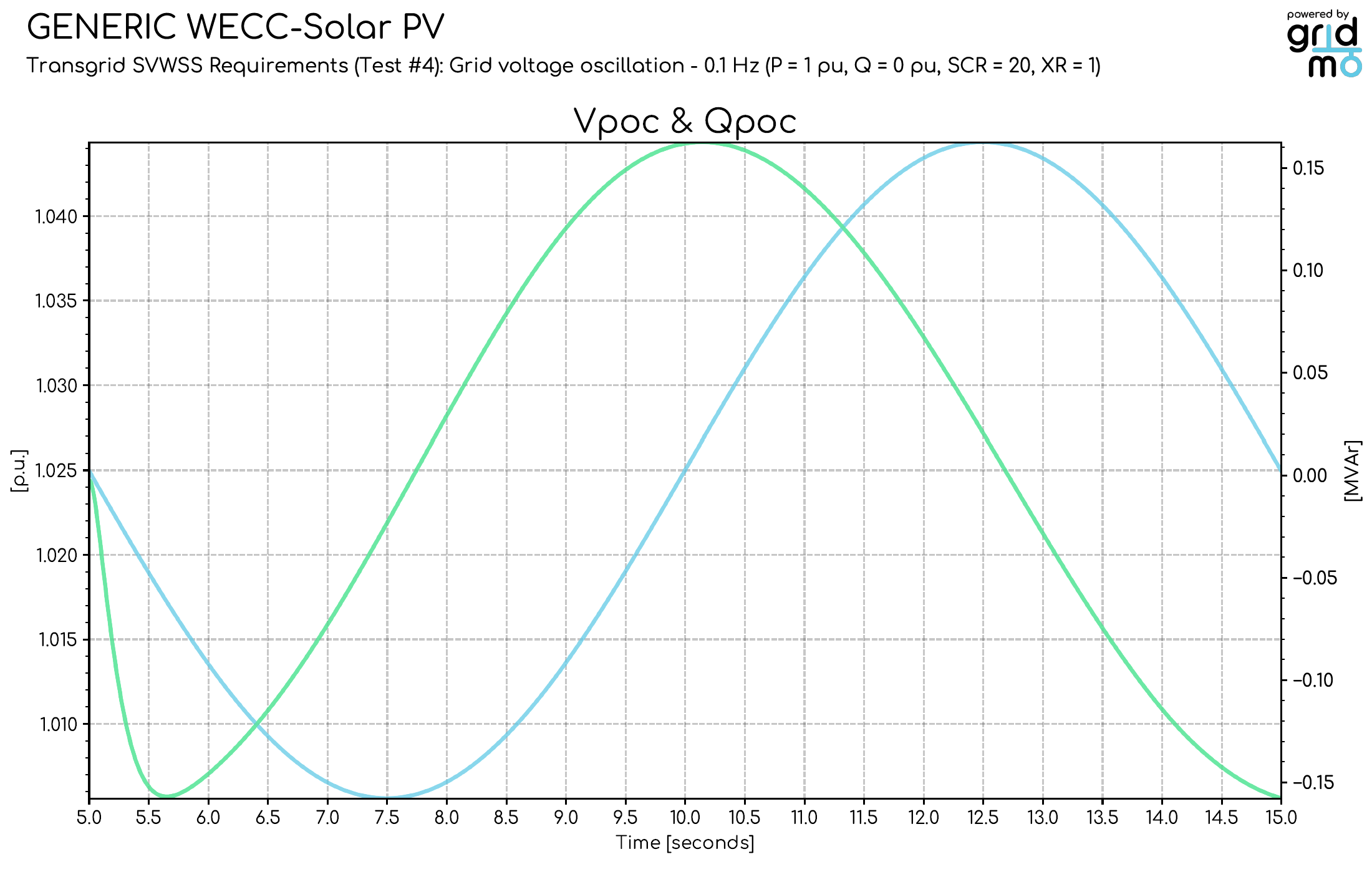
The purpose of these tests is to monitor the oscillation rejection capability of the GFM BESS.
- The test description states that the voltage oscillation can be created by "making a fictitious GFL generator co-located at the same controlled bus", but also references DMAT tests 190-192 as an alternative SMIB methodology where the test is performed via playback generator. We have opted to use the DMAT methodology for this test.
- For the Vpoc overlay without the GFM BESS in service, it is assumed that Vpoc (without the GFM BESS) = Vthev due to the open circuit from opening the POC circuit breaker. This is preferred to doubling the number of PSCAD simulations by opening the POC circuit breaker and repeating all the simulations to measure Vpoc.
Test 7-9: Frequency event at different ROCOFs (via playback)
The purpose of these tests is to observe the response of the GFM BESS to frequency disturbances at different ROCOFs, with and without frequency and inertial control enabled.
- The test description states that the frequency event must be selected such that "the pre and post fault voltage angle be within 20 degrees without the participation of BESS". However the requirements also state that the purpose of the test is to observe the GFM BESS's compliance to PFR (Primary Frequency Response) and FFR (Fast Frequency Response). As such, it is assumed that the frequency disturbance selected has to be large enough to (at least) observe the frequency control function of the GFM BESS. We were unable to achieve both of these test conditions, as the voltage angle pre and post fault exceeded 20 degrees when the frequency disturbance was large enough for the frequency control function to be observed. Hence, the frequency disturbance chosen was +/- 0.05 Hz (to 49.95 Hz and 50.05 Hz).
- The change in active power (ΔP) for the ΔP vs ROCOF scatter plot is calculated as the difference in active power from the start of the frequency disturbance to when the frequency reaches its final value (i.e. time at which it reaches 50.05 Hz or 49.95 Hz).
Test 10-12: Local faults at controlled bus
The purpose of these tests is to check the voltage magnitude and angle performance of the GFM BESS due to a fault at the controlled bus.
- As the duration and severity of the faults are not specified, faults at 50% residual of 430 ms duration have been chosen.
- For Test 10, a 3PH fault has been applied instead of a 3PHG fault as PSS®E does not natively support 3PHG faults.
- We have assumed "response time" is to be calculated as per the definition of "step response time" provided in Figure 5 of IEEE Std 2800™-2022.
Test 13: Multiple faults concurrent with a frequency event
The purpose of this test is to observe the performance of the GFM BESS during voltage and frequency disturbances which are applied concurrently.
- As the severity of the frequency disturbance has not been specified, a +/- 0.5 Hz disturbance (to 49.5 Hz and 50.5 Hz) at 1 Hz/s has been chosen.
- As the severity and duration of voltage disturbances has not been specified, 3PH faults of 120 ms duration at fault depths of 0%, 25% and 50% have been chosen.
- As the time between faults has not been specified, the time between faults is chosen as 20 ms.
Test 14: Trip of a local synchronous machine
Test 14 is not currently included in this template. It requires a model which has a synchronous generator modelled local to the GFM BESS.
Test 15: Load rejection and extreme overvoltage disturbance
The purpose of this test is to observe the performance of the GFM BESS during transient overvoltage (TOV) events.
- It is assumed that the purpose of this test is to assess the performance of the GFM BESS for TOV and immediate reactive power absorption after a load reduction event has occurred. As such, the load reduction event itself (via a frequency disturbance or otherwise) is not simulated in this test.
- As the severity and duration of the 'extreme overvoltage' has not been specified, a 1.15 pu overvoltage of 900 ms duration has been chosen for this test.
Test 16: Energising RL loads in island mode (Black Start Service only)
Test 16 is not currently included in this template. It requires a model which can demonstrate the energisation of loads when the GFM BESS is in island mode with no infinite bus machine.
Test 17: Unbalanced voltage disturbance
The purpose of this test is to observe the performance of the GFM BESS (voltage angle and magnitude changes) for an unbalanced voltage disturbance.
- As the severity and duration of the "small voltage" disturbance has not been chosen, a PHG fault of 95% residual for a duration of 120 ms has been chosen.
- The test description states that the unbalanced network condition can be created by "adding a RL load to one phase of the line between POC and the network bus". However, as gridmo's smiby block does not support this, the unbalanced voltage disturbance has been created using the
SIMPLEFAULTcommand which effectively adds an RL load between POC and ground on one phase of the line.
Sources
- Transgrid | Transgrid's technical performance and power system modelling requirements for stable voltage waveform support services from grid-forming BESS | 17 June 2024
- AEMC | National Electricity Rules | Version 234 | 21 August 2025
- IEEE Std 2800™-2022
Revision history
Version 1 | 27 November 2025
- First release.