Template: AEMO PSS®E v34-v36 Benchmarking Requirements

Template version: v4
Country:

AU
Software required:
Source: AEMO | PSS®E 36 Transition | 29 July 2025
How to add this template to your project
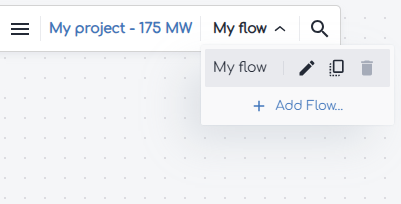
- From within your gridmo project, open the flow dropdown and select 'Add flow'.
- Select the template you want to use and click 'Add to project'.
Background
As of 4 August 2025, AEMO requires dynamic models to be provided in both PSS®E v34 and v36 formats with a full transition to v36 expected by 1 July 2026. As part of this transition, AEMO has specified a series of tests in the PSS®E 36 Transition document to demonstrate benchmarking between v34 and v36 models. The document also makes a distinction between site-specific and full benchmarking requirements, with site-specific requirements being a subset of the full benchmarking requirements.
The table below outlines which tests are required for each type of requirement:
| Test number | Test description | Site-specific benchmarking requirements | Full benchmarking requirements |
|---|---|---|---|
| 001 | Steady state flat runs | ❌ | ✅ |
| 002 | Playback of swing bus voltage changes - small voltage changes | ❌ | ✅ |
| 003-003b | Playback of swing bus voltage changes - overvoltage and undervoltage protection | ✅ | ✅ |
| 004 | Playback of swing bus frequency changes - small frequency changes | ❌ | ✅ |
| 004a-004b | Playback of swing bus frequency changes - overfrequency and underfrequency protection | ✅ | ✅ |
| 005 | Vref step changes | ✅ | ✅ |
| 006-007 | Pref step changes | ❌ | ✅ |
| 007b-007c | Pref step changes while playback of a small change in swing bus frequency | ✅ | ✅ |
| 008-008e | Trip line and reclose | ❌ | ✅ |
| 009 | Trip of a bus | ❌ | ✅ |
| 010 | Trip of a generator | ✅ | ✅ |
| 011-025 | Voltage dip at POC - unbalanced faults | ❌ | ✅ |
| 026-030 | Voltage dip at POC - balanced faults | ✅ | ✅ |
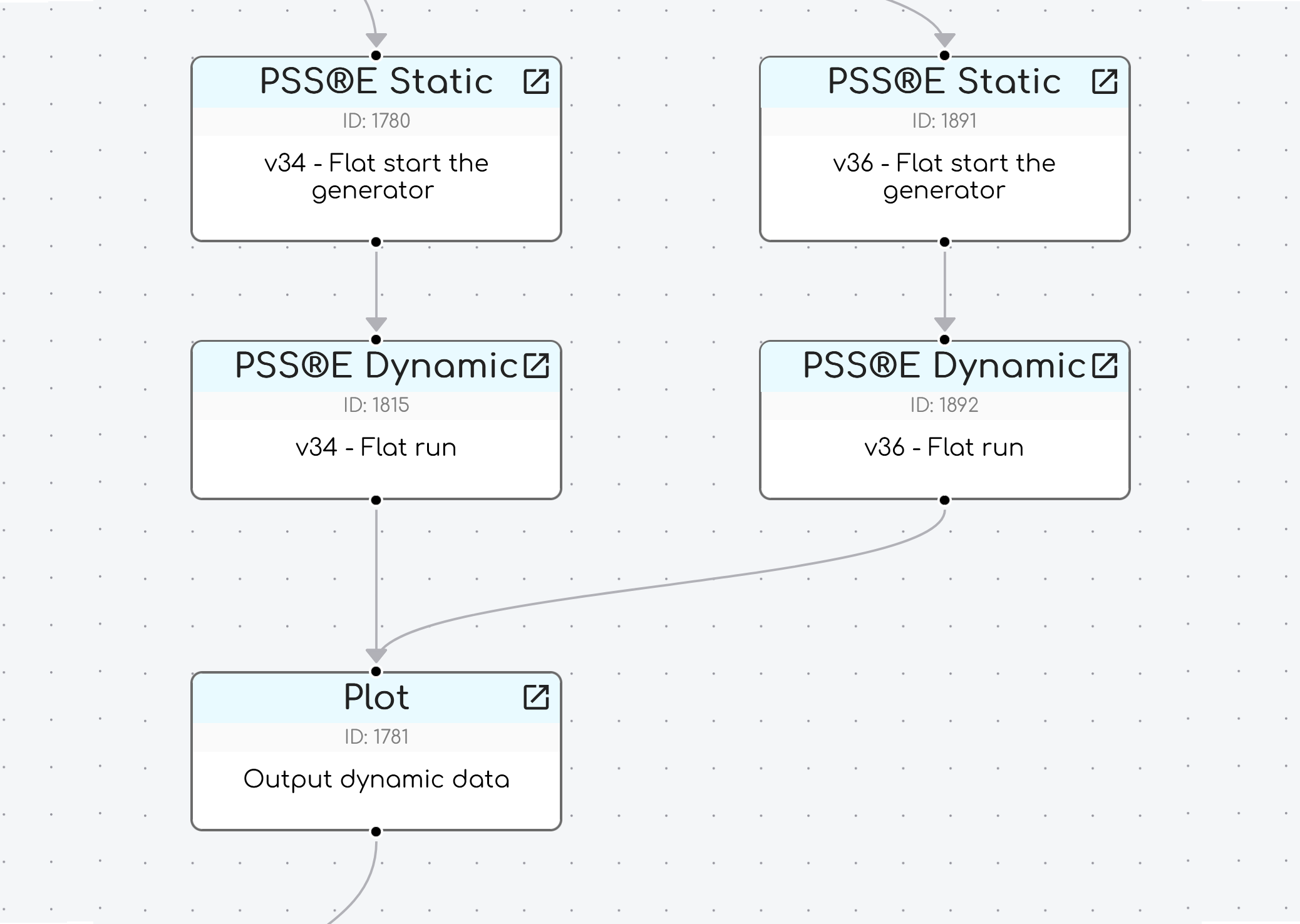
By default, this template has been configured to only run the tests required for site-specific benchmarking.
This template can be configured to run either the site-specific or full benchmarking requirements, noting that the Loop Variable l_full_or_ss has been created to distinguish between the two types of requirements.
Reference
Common assumptions
- Initial Vpoc and Qpoc values is not explicitly defined for all tests. We have assumed the following initialization conditions: Vpoc=1.0 [p.u.] and Qpoc=0 [MVAr].
- We have assumed that bus and line numbers in the v34 and v36 case files are identical. Therefore, we have not provided v36-specific PSS®E Static Node Global Variables.
- For Hybrid plants, AEMO states, "If the plant controller is expected to control a hybrid plant, then the plant should be [configured] as a typical hybrid plant with all generators in service." We therefore assume that the tests within this template don't need to be completed across all scenarios.
The AEMO methodology for defining contingencies is often to define the fault impedance as a ratio of the Thévenin equivalent source impedance, Zthev (e.g. Zf=Zs in Table 3 of DMAT or Rf = Grid_R% * Rthev and Xf = Grid_X% * Xthev in the AEMO PSS®E v34-v36 Benchmarking Requirements).
This methodology does not consider Vthev and therefore the observed connection point residual voltage (Vf) may change significantly depending on the steady state initial conditions and the subsequently calculated Vthev value. Having the residual voltage of the test change depending on initial conditions can be undesirable during review, especially for low SCR operating conditions where the observed effect is greater.
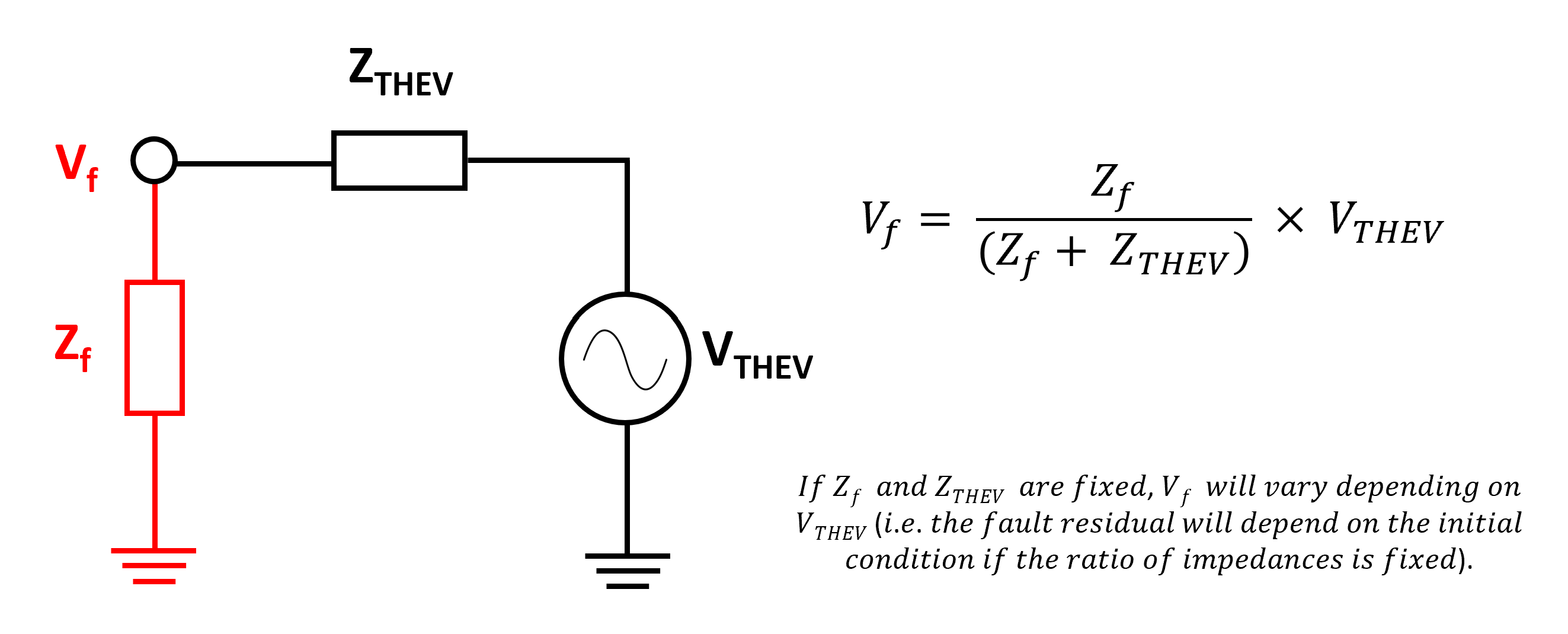
Rather than specifying a ratio of fault impedance to Thévenin equivalent impedance, it is common industry practice to instead specify a target residual voltage. Therefore, the fault impedance calculation will take into the steady state initial conditions and the subsequently calculated Vthev value (see Udip in Equation (1) of the AEMO DMAT Guideline). Therefore, we have specified particular residual voltages for each contingency, noting that we are still observing the desired Xf/Rf ratio. Additionally, given the purpose of the template is benchmarking the performance between PSS®E v34 and v36 models, the most important outcome is that the fault impedance is the same between tests.
Test 001: Steady state flat runs
The purpose of these tests is to demonstrate the both v34 and v36 models initialize correctly and run in a robust manner.
Test 002-003b: Playback of swing bus voltage changes
The purpose of these tests is to demonstrate that both v34 and v36 models have the same default reactive power control mode response to small grid voltage disturbances and the same voltage protection settings in respond to large grid voltage disturbances.
The under-voltage protection disturbances were applied using a balanced fault, rather than a playback generator model. This methodology helps to avoid using a Thévenin equivalent voltage source playback for very low voltage dips which has been known to cause unrealistic and undesirable generating systems responses.
Test 004-004b: Playback of swing bus frequency changes
The purpose of these tests is to demonstrate that both v34 and v36 models have the same active power control response to small grid frequency disturbances.
Test 005: Vref step changes
The purpose of these tests is to demonstrate that both v34 and v36 models have the same voltage control mode response to voltage reference step changes.
Test 006-007c: Pref step changes
The purpose of these tests is to demonstrate that both v34 and v36 models have the same active power control response to active power reference step changes and active power step changes while playback of swing bus frequency changes.
Test 008-008e: Trip line and reclose
The purpose of this test is to benchmark your model between PSS®E v34 and v36 by performing a trip and reclose of a line that is "connecting the POC to the external grid".
We've assumed the intention of this test is to demonstrate the response of the v34 and v36 model match during an islanding event. Therefore, we've chosen to trip the Thévenin equivalent source impedance branch.
Test 009: Trip bus
The purpose of these tests is to benchmark your model between PSS®E v34 and v36 by performing a trip of a bus.
We've assumed the intention of this test is to demonstrate the response of the v34 and v36 model match during an islanding event. Therefore, we've chosen to trip the point of connection bus.
Test 010: Trip generator
The purpose of these tests is benchmark your model between PSS®E v34 and v36 by performing a trip of a single generator in your model.
Test 011-025: Voltage dip at POC - unbalanced faults
The purpose of these tests is to benchmark your model between PSS®E v34 and v36 by applying unbalanced faults at the POC bus at different fault impedances.
Test 026-030: Voltage dip at POC - balanced faults
The purpose of these tests is to benchmark your model between PSS®E v34 and v36 by applying balanced faults at the POC bus at different fault impedances.
Sources
- AEMO | PSS®E 36 Transition | 29 July 2025
- AEMO | PSS®E V34 and V36 dynamic model benchmark tool | Version 1.0.3 | 21 July 2025 (not publicly available)
Revision history
Version 4 | 28 November 2025
Fixed- Fixed Test 007b-007c Pref steps to return to initial Pref value at 50 seconds, instead of remaining at the Pref step taken at 30 seconds. Changed
RELVAL=argument fromRELVAL=0toRELVAL=-0.2for Test 007b and toRELVAL=0.5for Test 007c.
Version 3 | 12 October 2025
Fixed- Updated global variable, "psse_v36_dll_folder" from "" to "psse".
Version 2 | 8 September 2025
New- Update the template based on the latest version of the AEMO transition document (AEMO | PSS®E 36 Transition | 29 July 2025).
- Created new global variable
psse_v34_versionwhich is used to set PSS®E Version 34. - Created a new loop variable
l_full_or_sswhich indicates whether a test is part of the full benchmarking requirements or site-specific benchmarking requirements. Note, tests which are only required for the full benchmarking requirements are disabled by default. - Added a new test for Pref step changes while playback of a small change in swing bus frequency, as per the latest update to AEMO's PSS®E 36 Transition document.
- Added a new set of tests for balanced faults (SS027-SS029) at 0%, 50% and 80% fault residuals for site-specific benchmarking requirements, as specified in the latest update to AEMO's PSS®E 36 Transition document.
- All tests are now conducted at SCR=3 and X/R=3 instead of SCR=
$min_scrand X/R=$min_xr, as per latest update to AEMO's PSS®E 36 Transition document. - Set global variables
psse_v36_versionandpsse_34_versionfrom full versions to partial versions (i.e.36instead of36.X.Y), as gridmo now automatically looks for the latest version of PSS®E v34/v36.
- Removed
psse_ds_change_source_energycommand from PSS®E Dynamic Nodes1795and1898for frequency disturbance tests.
Version 1 | 17 Jun 2025
- First release.