Template: CEA Technical Standards for Connectivity to the Grid (CTU Tests)

Template version: v1
NEW!Country:

IND
Software required:
Source: CTU | List of studies/tests to be conducted by RE Generators/Parks in process of submission of final technical connection data for demonstrating compliance with CEA technical standards for connectivity to the grid | Rev.0 | 09 March 2025
How to add this template to your project
- From within your gridmo project, open the flow dropdown and select 'Add flow'.
- Select the template you want to use and click 'Add to project'.

Background
Grid connection requirements in India are defined through a combination of regulations issued by the Central Electricity Authority (CEA) and the Central Electricity Regulatory Commission (CERC), primarily via the CEA Technical Standards for Connectivity to the Grid (TSCG) and the Indian Electricity Grid Code (IEGC).
The CEA Technical Standards establish the technical standards for connection to the transmission system, including performance capabilities for renewable energy generators. Renewable generators are required to submit tests and study reports to the Central Transmission Utility (CTU) as part of the connection process.
This template includes the tests specified by CTU to demonstrate compliance with the CEA Technical Standards, in both RMS and EMT platforms. These include the following:
| Test | Relevant Regulation Clause |
|---|---|
| Reactive power capability test | CEA TSCG: Part-II.B2(1) |
| Capability to operate in frequency range: 47.5 Hz to 52 Hz | CEA TSCG: Part-II.B2(2) |
| Capability to provide rated output in frequency range of 49.5 Hz to 50.5 Hz | CEA TSCG: Part-II.B2(2) |
| Low voltage ride through | CEA TSCG: Part-II.B2(3) |
| Active power setpoint and rate of change of active power | CEA TSCG: Part-II.B2(4)(i) |
| Frequency response test | CEA TSCG: Part-II.B2(4)(ii,iii), IEGC: 30(10) |
| Demonstration of immediate real power primary frequency response | CEA TSCG: Part-II.B2(4)(ii,iii) |
| High voltage ride through | CEA TSCG: Part-II.B2(7) |
Reference
Common assumptions
- Power quality tests (such as current harmonics, DC current injection and flicker study) in EMT platform (Section 1, Part 4 of the CTU test document) and not currently part of this template.
- All tests performed at the SCR and X/R specified by the Global Variables
$ind_cea_standards_scrand$ind_cea_standards_xr. By default these are set to SCR=5 and X/R=10, as per Section K of the CTU test document. - By default, all Plot Nodes are configured to benchmark PSS®E and PSCAD™ results. This is the recommended approach due to its simplicity. If desired, you can enable the PSCAD™ only and PSS®E only Plot Nodes to submit separate DMAT reports for each software package.
Reactive power capability test
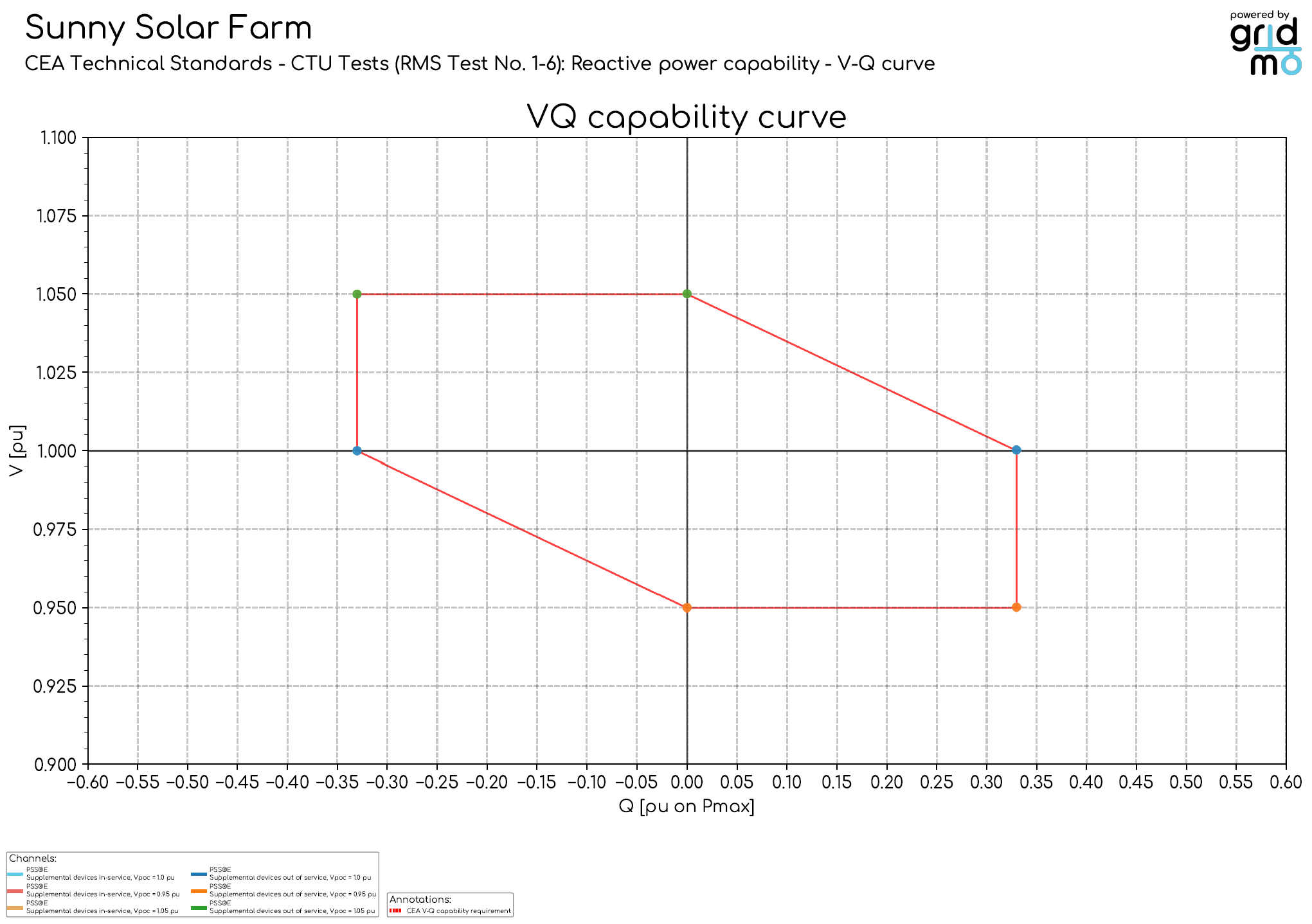
The purpose of this test is to demonstrate the reactive power capability of your generator.
- To demonstrate that your generator meets CEA's V-Q curve criteria, the operating points we have chosen are the corner points of the V-Q capability requirement which corresponds to Qmax and Q=0 MVAr when the voltage at POI = 0.95 pu, as well as Qmin and Q=0 when the voltage at POI = 1.05 pu.
- The test document specifies the test to be performed at a finite SCR (as specified by the Global Variable
$ind_cea_standards_scr). However we recommend performing this test at infinite SCR to prevent your generator from affecting the voltage at POI, thus not giving the exact voltage to satisfy the test criteria. By default, this test has been setup to be performed at infinite SCR. - For this test, we have assumed the transformer tap position is not locked (i.e. free to move) during this test.
Capability to operate in frequency range: 47.5 Hz to 52 Hz
The purpose of this test is to demonstrate your generator's ability to operate in the frequency range of 47.5 Hz and 52 Hz.
- A rate of change of frequency (RoCoF) of 4 Hz/s has been chosen when changing the frequency during this test.
- The test document specifies the generator may initialize at any power factor, hence this template initializes the generator at an initial Q specified by the global variable
$project_q_normal_pu, i.e. the typical reactive power when the generating system is at normal operating voltage. - The test document specifies the PPC frequency flag to be off for the simulation. We have assumed this is referring to the frequency control functions of the generator, which are configured by the Global Variables
$psse_freq_flag_off,$psse_freq_flag_on,$pscad_freq_flag_offand$pscad_freq_flag_on. - It is unclear what simulation duration the test should be performed for, hence a simulation duration of 30 seconds has been chosen by default.
- The test document specifies the test to be performed with '± 5% voltage variation'. As such, this test has been performed at POI voltage = 0.95 pu and 1.05 pu, as well as POI voltage = 1.0 pu.
Capability to provide rated output in frequency range of 49.5 Hz to 50.5 Hz
The purpose of this test is to demonstrate your generator's ability to provide rated output in the frequency range of 49.5 Hz and 50.5 Hz.
- A rate of change of frequency (RoCoF) of 4 Hz/s has been chosen when changing the frequency during this test.
- The test document specifies the PPC frequency flag to be off for the simulations. We have assumed this is referring to the frequency control functions of the generator, which are configured by the Global Variables
$psse_freq_flag_off,psse_freq_flag_on,pscad_freq_flag_offandpscad_freq_flag_on. - It is unclear what simulation duration the test should be performed for, hence a simulation duration of 30 seconds has been chosen by default.
Low voltage ride through
The purpose of this test is to demonstrate your generator's low voltage ride through capability.
- The test document does not specify the initial reactive power the generator should initialize at, hence Q is initialized at the typical reactive power when the generating system is at normal operating voltage, specified by the global variable
$project_q_normal_pu.
Active power setpoint and rate of change of active power
The purpose of this test is to demonstrate your generator's ability to operate in active power control mode.
- To demonstrate the active power ramp up and ramp down tests, we have chosen a magnitude change of 10% (of the generator's rated active power). Hence, for the ramp up test, the initial dispatch is at 90% which ramps up to 100% of the project rated active power. For the ramp down test, the initial dispatch is 100% and ramps down to 90% of the project rated active power.
Frequency response test
The purpose of this test is to demonstrate your generator's ability to respond to frequency changes.
- A rate of change of frequency (RoCoF) of 4 Hz/s has been chosen when changing the frequency during this test.
- The frequency change step sizes for this test are: ± 0.01 Hz, ± 0.02 Hz, ± 0.03 Hz, ± 0.05 Hz, ± 0.075 Hz, ± 0.1 Hz, ± 0.125 Hz and ± 0.15 Hz. If required, the frequency change step sizes chosen in this test in the Loop Variable
$l_frequency_changecan be modified to show insensitivity to the frequency change until the deadband is exceeded.
Demonstration of immediate real power primary frequency response
The purpose of this test is to demonstrate your generator's ability to provide an immediate real power primary frequency response for frequency deviations in excess of 0.3 Hz.
- A rate of change of frequency (RoCoF) of 4 Hz/s has been chosen when changing the frequency during this test.
High voltage ride through
The purpose of this test is to demonstrate your generator's high voltage ride through capability.
- The CTU test document specifies that RMS Test No. 38-40 are to be performed with an initial active power dispatch of 0.2 pu, however the equivalent test in EMT (Test No. 72-74) are specified with an initial active power dispatch of 0.25 pu. We have assumed this is an error in the document, so we have configured the RMS tests with an initial active power dispatch of 0.25 pu to also allow for benchmarking with the EMT simulations.
- The test document does not specify the initial reactive power the generator should initialize at, hence Q is initialized at the typical reactive power when the generating system is at normal operating voltage, specified by the global variable
$project_q_normal_pu. - For tests with target voltage 1.1 pu, the test requirement states the duration of the voltage rise must be 'continuous'. For the purpose of simulation, we have sustained the voltage rise for 10 seconds and assumed that is satisfactory to demonstrate the requirement.
Sources
- List of studies/tests to be conducted by RE Generators/Parks in process of submission of final technical connection data for demonstrating compliance with CEA technical standards for connectivity to the grid | Rev.0 | 09 March 2025 (not publicly available)
- Central Electricity Authority (Technical Standards for Connectivity to the Grid) Regulations, 2007 | 21 February 2007
- Central Electricity Authority (Technical Standards for Connectivity to the Grid) (Amendment) Regulations, 2013 | 15 October 2013
- Central Electricity Authority (Technical Standards for Connectivity to the Grid) (Amendment) Regulations, 2019 | 08 February 2019
Revision history
Version 1 | 20 April 2026
- First release.