Template: Fingrid modelling instructions for PSS®E and PSCAD™ models (VJV2024)

Template version: v1
NEW!Country:

FI
Software required:
Source: Fingrid | VJV2024 - Grid Code Specifications for Power Generating Facilities | 15 Jan 2025
How to add this template to your project
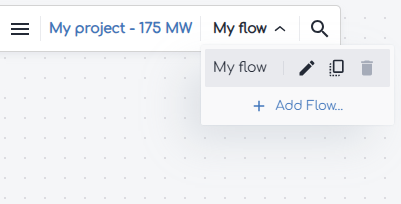
- From within your gridmo project, open the flow dropdown and select 'Add flow'.
- Select the template you want to use and click 'Add to project'.
Background
Fingrid's VJV2024 Grid Code Specifications for Power Generating Facilities outline the technical requirements for connecting generation to the Finnish power system. As part of grid compliance, simulation models of power generating facilities need to be provided in accordance with Fingrid's modelling instructions for PSS®E and PSCAD™ models.
This template includes the tests specified by Fingrid's modelling instructions for PSS®E and PSCAD™ models under VJV2024's Grid Code Specifications for Power Generating Facilities.
Reference
Common assumptions
- For tests where the initial reactive power is not specified by the test template, the initial reactive power is set as per the Global Variable
$project_q_normal_puwhich is typically set as Q=0. - For tests where the initial voltage is not specified by the test template, the initial voltage at the connection point is set as per the Global Variable
$project_v_normal. - The term "SCR Normal" in the test template has been interpreted as the maximum SCR that the power generating facility operates under and is set as per the Global Variable
$scr_max. Similarly, the test X/R ratio is not specified so we have assumed the maximum X/R ratio as set by the Global Variable$xr_max. - It is unclear if the PSS®E and PSCAD™ results should be benchmarked/overlaid or displayed on separate plots. The two dynamic simulation results have been overlaid in this template, but can be separated if desired.
Test G1: Setpoint changes
The purpose of these tests is to confirm the power generating facility's ability to operate correctly when given voltage, reactive power, power factor and active power control setpoints.
- All control setpoint changes are spaced 10 seconds apart, as the duration is not specified in the test template.
- For test G1.2, the Q-control setpoint changes specified in the test template are assumed to be on the power generating facility's rated active power (Pmax) base.
Test G2: Frequency modes
The purpose of these tests is to confirm the power generating facility's ability to operate in frequency sensitive mode and limited frequency sensitive mode.
- The frequency disturbances are sustained for 10 seconds, as the duration of the disturbances is not specified in the test template.
- The frequency disturbances are applied using a rate of change of frequency of 2 Hz/s, as per Section 10.2.2 of VJV2024.
- For tests G2.1-G2.2, we have assumed the intention of the test is to isolate the operation of frequency sensitive mode. Hence, limited frequency sensitive mode is disabled using the Global Variables
$psse_ds_disable_lfsmand$pscad_disable_lfsm. - For tests G2.3-G2.4, we have assumed the intention of the test is to isolate the operation of limited frequency sensitive mode. Hence, frequency sensitive mode is disabled using the Global Variables
$psse_ds_disable_fsmand$pscad_disable_fsm. - For tests G2.2 and G2.4, we have assumed that performing the tests "without active power reserve" requires the power generating facility's available power to be limited, such that there is no available power for active power increase (i.e. available power = 0.5 pu when the generating facility is initialized at Ppoc = 0.5 pu). This is typically achieved by configuring source energy values (i.e. irradiance or wind speed) in the project's model. In the template, this is configured using the Global Variables
$pscad_change_source_energyand$psse_ds_change_source_energy, in addition to the Loop Variables$l_pscad_p_reserveand$l_psse_p_reservein Loop: Start Nodes1131and1792.
Test G3: Operating limits - voltage and frequency
The purpose of these tests is to confirm the power generating facility's ability to operate at its voltage and frequency operating limits.
- The test template acceptance criteria states the power generating facility must demonstrate "stable operation" for these tests. We have assumed the criteria below to satisfy "stable operation" as per the checks performed in Analysis Nodes
1803and1804:- The power generating facility does not trip.
- The power generating facility's active and reactive power output at the connection point after the disturbance is the same as the pre-disturbance values.
- For tests G3.1-G3.2, the voltage disturbances are sustained for 10 seconds as the duration is not specified in the test template.
- For tests G3.3-G3.4, the frequency disturbances are sustained for 10 seconds as the duration is not specified in the test template.
- For tests G3.3-G3.4, the acceptance criteria states that the "active power reduction is not more than 10% per 1 Hz when frequency is below 49.0 Hz". We assume the 10% reduction is referring to 10% of the power generating facility's rated active power - i.e. 10% of Pmax.
- The frequency disturbances are applied using a rate of change of frequency of 2 Hz/s, as per Section 10.2.2 of VJV2024.
Test G4: Reactive power capability and compensation equipment
The purpose of these tests is to confirm the power generating facility's reactive power capability and the compensation equipment logic.
- For test G4.1 and G4.2, we have assumed the intention is to confirm the power generating facility's ability to operate at reactive power limits, while subject to network voltage changes. Hence, we have performed this test at reactive power limits (Qmax and Qmin), while forcing the power generating facility to be in reactive power control mode.
- For test G4.3, we have assumed the power generating facility should be in voltage control mode in order to satisfy the test criteria of "reactive power shall be produced for a minimum of 10 seconds".
- For tests G4.4-G4.5, we have assumed the intention of this test is to observe the power generating facility's active power response after the connection/disconnection of the compensation equipment.
Test G5: Step response test
The purpose of these tests is to confirm the power generating facility's response to network voltage changes and voltage setpoint changes.
- For the "performance criteria" in the test template, we have added an additional set of tests to evaluate the generator's response to +/- 0.02 pu voltage disturbances. We have evaluated the performance calculations at different voltage levels (0.9 pu, 1 pu and 1.05 pu) as per the voltage fluctuation range in Fingrid's network as per VJV2024 Section 10.1.
- For the performance calculations, we have assumed a test duration of 15 seconds and assumed this is satisfactory as the Vpoc settling time requirement is 5 seconds after the disturbance (which is applied at 5 seconds).
Test G6: Fault ride through and fault current injection
The purpose of these tests is to confirm the power generating facility's fault ride through and fault current injection capability.
- For test G6.2, we have assumed the applied voltage disturbances to test the overvoltage withstand capability are as per Figure 10.4 (Section 10.3.3) of VJV2024.
- For test G6.3, we have assumed the 3 phase faults of 100 ms are bolted faults as the fault severity is not specified in the test document.
- For test G6.3, we have interpreted "expected performance" in the acceptance criteria as the power generating facility's ability to ride through the faults without tripping. This check has been performed in Analysis Node
1815. - For tests G6.4.1-G6.4.3, the duration of the faults to be applied is not specified in the test document. We have assumed a fault duration of 250 ms, as this is the longest fault duration in Table 10.3 and Table 10.4 in Section 10.5.4 of VJV2024.
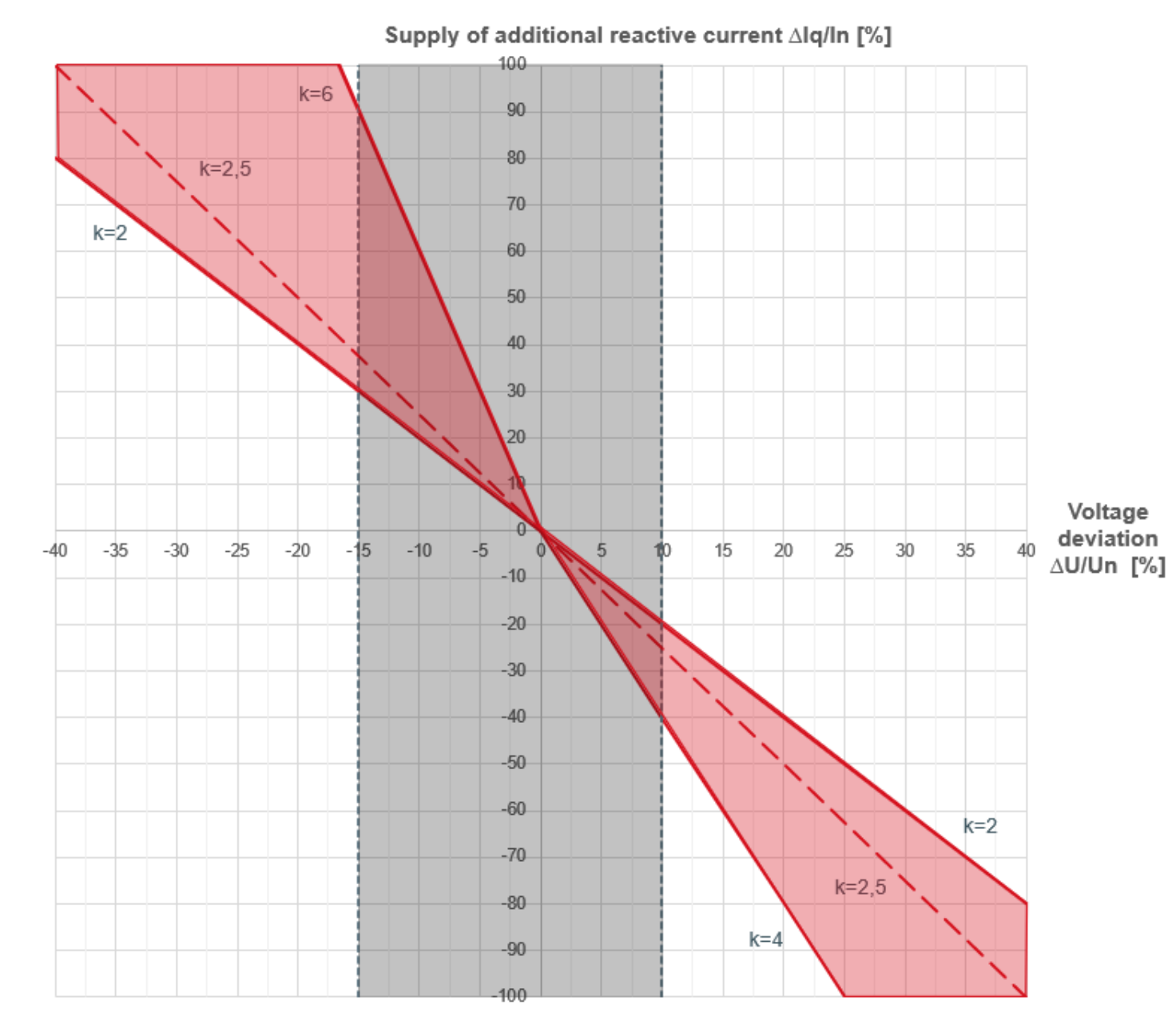
- For tests G6.4.1-G6.4.3, the k-factor plots from Plot Nodes
1733,1744and1757show the acceptable range for k-factor (k=2 and k=6), which is as per VJV2024 Section 18.1.2 for a power generating facility equipped with a full converter (FC). Note that the k-factor requirement is different for double fed induction generators (DFIG) for inductive reactive current (between k=2 and k=4). - For test G6.4.1, the test template specifies 3 phase to ground faults need to be applied, however we have applied 3 phase faults in our template as PSS®E does not natively support 3 phase to ground faults.
Test G7: Voltage and frequency protections
The purpose of these tests is to confirm your power generating facility's voltage and frequency protection.
- The test document does not specify the voltage and frequency levels the power generating facility should be subject to, in order to trigger the protection functions. Hence, the following levels have been chosen:
- Test G7.1: Voltage is raised to 1.35 pu.
- Test G7.2: Voltage is lowered to 0.1 pu.
- Test G7.3: Frequency is raised to 55 Hz.
- Test G7.4: Frequency is lowered to 45 Hz.
- The test document does not specify the duration of the frequency and voltage disturbances. We have assumed a duration of 20 seconds for the voltage disturbances (at 1.35 pu and 0.1 pu). Similarly, we have assumed a duration of 15 seconds for the frequency disturbances (at 45 Hz and 55 Hz).
- The frequency disturbances are applied using a rate of change of frequency of 0.5 Hz/s.
Test A4/C4: Initialization
The purpose of this test is to ensure your PSS®E and PSCAD™ model initialize under the required criteria.
Sources
- Fingrid - Grid Code Specifications for Power Generating Facilities (VJV2024) - 15 January 2025
- Fingrid - PSS/E test template VJV2024 - 10 February 2026
- Fingrid - PSCAD test template VJV2024 - 10 February 2026
Revision history
Version 1 | 20 May 2026
- First release.