Template: KraftNAV - New connection of conventional generation plants

Template version: v1
Country:

DE
Software required:
Source: TenneT Germany | Power plant grid connection procedure according to KraftNAV | 21 November 2019
How to add this template to your project
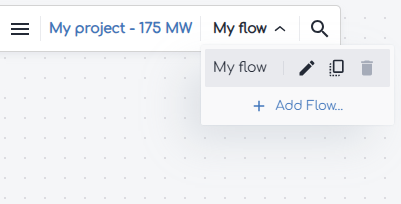
- From within your gridmo project, open the flow dropdown and select 'Add flow'.
- Select the template you want to use and click 'Add to project'.
Background
TenneT Germany is responsible for connecting new generation systems in accordance with KraftNAV. The document, "Kraftwerks-Netzanschlussverfahren nach KraftNAV- Unterlagenliste", which translates to "Power plant grid connection procedure according to KraftNAV document list", contains tests to prove behaviour during particular events.
Reference
Common assumptions
- Supporting documentation like the requirements of Appendix A are required but are not included in this template.
- The tests in this document focus on the requirements of clause 3.2.
- The source document primarily refers to connecting "conventional generating plants" (i.e. synchronous generating systems). However, it is assumed that this template can also be used for asynchronous generating systems
- Although not specifically requested, equivalent tests have been included for PSCAD™ in case of adoption of the software in the future. By default, these Nodes are disabled.
- gridmo's commands use Xf/Rf, rather than Rf/Xf - as specified in the source document. Equivalent values have been chosen where appropriate.
- Faults are applied at 5s, not 1s to accommodate running an equivalent simulation in PSCAD™.
3.2.1: Balanced faults
The purpose of section 3.2.1 is to demonstrate your generating system's ability to ride through balanced faults.
gridmo's commands use Xf/Rf, rather than Rf/Xf (i.e. as specified by TenneT). The test requires Rf/Xf = 0, which corresponds to Xf/Rf=INF. We don't currently have the ability to set Xf/Rf = INF. Therefore, Xf/Rf is set as a very high value (i.e. 9999) such that Rf/Xf ≈ 0.
3.2.2: Stability limit
The purpose of section 3.2.2 is to find the stability limit of your generating system. This test is primarily designed to find the fault duration which will cause a synchronous generator to lose synchronism. However, this test may still be useful for asynchronous generating systems to investigate the system's fault ride-through capability.
Sources
- BMJV | KraftNAV | 26 June 2007
- TenneT Germany | Power plant grid connection procedure according to KraftNAV | 21 November 2019
Revision history
Version 1 | 6 August 2025
New- First release.
Related templates
- N/A